Best Blinds for Casement & Crank Windows (and Double-Hung)

Double-hung and casement windows are two of the most common window types, and each has quirks that affect which coverings work best. From crank handles to sash operation, a little know-how gets you a clean fit. Here is how to choose coverings for double-hung and casement windows.
Double-hung vs casement: what changes
| Factor | Double-hung | Casement (crank) |
|---|---|---|
| How it opens | Sashes slide up and down | Swings outward on a hinge |
| Obstruction | None into the room | Crank handle projects inward |
| Usual mount | Inside mount | Outside mount |
| Easiest coverings | Almost anything | Cellular, roller, vertical |
| Hardest coverings | Few limits | Horizontal blinds, shutters |
| Key measurement | Depth of the reveal | Handle projection and sweep |
| Best picks | Faux wood blinds, cellular, roller, shutters | Outside-mount cellular or roller shades; motorized for hard-to-reach cranks |
Double-hung windows
Double-hung windows have two sashes that slide up and down, the classic, versatile window found in countless Houston homes. They accept almost any covering, blinds, shades, shutters, mounted inside or outside the frame. Inside-mount coverings look clean and built-in when the frame has enough depth, and they do not interfere with the sashes since the window slides vertically behind the covering.
Blinds for windows with cranks: your options
The crank handle is the whole problem. On a casement window it projects into the room, and a covering mounted inside the frame will knock against it every time you open the window. There are four practical ways around it: mount outside the frame so the covering hangs clear, choose a covering with a shallow stack that sits flush, fold or swap the handle, or motorize the shade so nothing has to reach past the crank. Which one is right depends on the window, and we work that out at the measurement.
Casement windows and the crank
Casement windows swing outward on a hinge, operated by a crank handle at the bottom, and that crank is the key consideration. An inside-mount covering must clear the crank handle so you can still open the window. Solutions include mounting the covering to clear or fold around the handle, choosing a low-profile shade, or using an outside mount that sits proud of the crank.
Measure the crank clearance first
Before you look at any product, measure two things on a casement window: how far the handle sticks out from the frame with the window closed, and the arc it sweeps when you turn it all the way. An inside-mount covering sits within the window opening, so it has to clear that handle with room to spare. If the handle projects close to the depth of the opening, an inside mount will not work without a fold-down handle or a deeper window reveal. We measure this on every casement at the free estimate.
Outside mount is usually the right answer
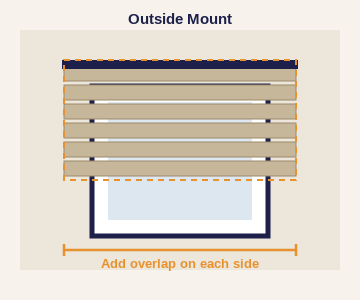
Mounting outside the opening, on the wall or trim above the window, moves the whole covering forward and clear of the handle. This is the default recommendation for casement windows and it solves the problem outright. It also has a side benefit: an outside mount overlaps the frame, which cuts the light gap at the edges and improves both room darkening and heat control. The tradeoff is that you see the covering rather than the window trim, so it reads a little heavier in the room.
Blinds with slats on crank windows
Horizontal blinds, faux wood or aluminium, will physically work on a casement window but they are the fussiest option. The bottom rail hangs at the exact height where the crank lives, and the tilt wand adds another thing to reach past. If you want blinds on a casement, mount them outside the opening and order them long enough that the bottom rail sits below the handle rather than level with it. Vertical blinds are a better fit than horizontal on wide casements because you can draw them to one side and clear the crank entirely.
Coverings that suit each
For double-hung windows, faux wood blinds, cellular shades, roller shades, and shutters all work beautifully, pick by style and function. For casement windows, cellular and roller shades and shutters work well as long as the crank clears, and low-profile options help. On a bank of casement windows, motorized shades avoid reaching around multiple cranks.
Getting the measurements right
Both window types reward precise measuring, especially casements, where crank clearance and swing must be accounted for so the covering works and the window still opens. A custom measure handles these details, which is exactly the kind of thing that trips up store-bought blinds. We measure for the covering and the window’s operation together.
Fold-down and removable crank handles
Many casement windows already have a handle that folds flat against the frame when it is not in use, which is often enough clearance for an inside-mount shade. If yours does not fold, replacement low-profile or removable handles are usually available for the window brand. This is the cheapest fix by far, and it is worth checking before you rule out an inside mount on looks alone.
Shutters and motorization on crank windows
Plantation shutters can be built on a frame that projects out from the window slightly, so the panels close in front of the crank rather than against it. It is a clean, built-in look that fully solves the clearance problem. Motorized shades solve a different half of it: with no cord or wand to reach for, you never have to work around the handle to operate the shade. On tall or awkward casement windows, motorization is often the difference between a covering you use and one you leave up.
What to avoid on casement windows
Deep horizontal blinds with a bulky headrail are the usual mistake on an inside mount, since the headrail eats the clearance you need for the crank. Very long cords are worth avoiding too, both for safety and because they tangle around the handle. If you want a horizontal blind on a casement, an outside mount with a slim headrail is the way to do it.
We fit every window type
Double-hung, casement, and every other window style each have a clean solution, and we fit them all regularly. At your free estimate we measure for both the look and the window’s operation, with free measuring and installation. Call or text (832) 772-7137.
Ready for a free in-home estimate?
We’ll measure, recommend the right options for your home, and give you an honest quote, with free installation included. Already know your sizes? Order online and we’ll send a free quote within 24 to 48 hours.